
Frozen Embryo Transfer (FET): Optimizing the Perfect Moment for Pregnancy
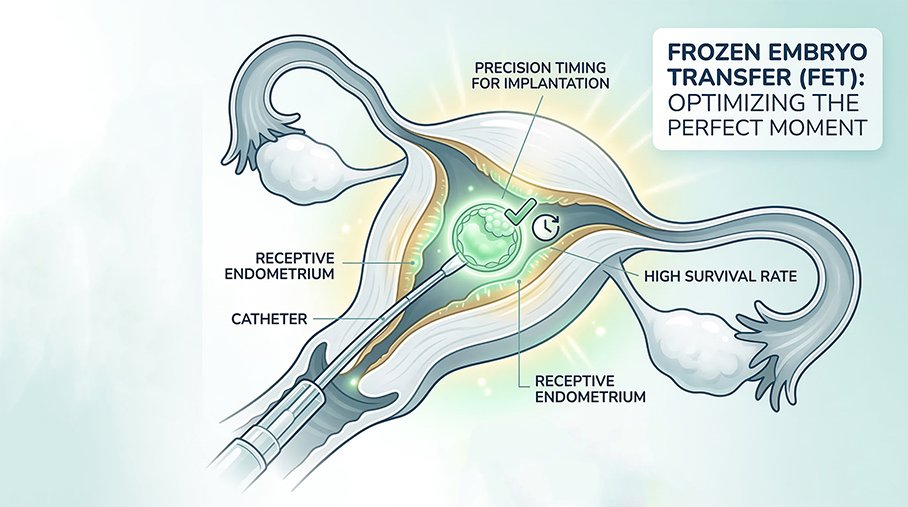
Frozen Embryo Transfer (FET) is a sophisticated procedure where embryos from a previous IVF cycle are thawed and gently placed into the uterus. By decoupling egg retrieval from the transfer, FET allows your body to recover from stimulation, ensuring the uterine lining is in its most receptive, natural state for implantation.
About This Treatment
What you need to know
Understanding the FET Advantage
Unlike a “fresh” transfer, which happens days after egg retrieval, an FET allows for a physiological “reset.” During ovarian stimulation, hormone levels are significantly higher than normal, which can sometimes make the uterine lining less receptive. FET gives us the luxury of time to prepare your endometrium using precise hormonal support, creating an environment that closely mimics a natural conception.
The Aikya FET Protocol: Step-by-Step
- Lining Preparation: You will begin hormonal & non-hormonal supplements at the start of your cycle to grow a healthy, thick uterine lining.
- Monitoring: We use high-resolution ultrasounds to measure the endometrial thickness and ensure it reaches the optimal 8-10mm range.
- Progesterone Support: Once the lining is ready, progesterone is introduced to “open” the window of implantation.
- The Thaw: Our embryologists use ultra-safe warming techniques to bring your vitrified embryos back to biological activity.
- Precision Transfer: The embryo is transferred into the uterus under ultrasound guidance, ensuring perfect placement.
Precision Embryology & Safety
At Aikya Fertility, our FET success rates are bolstered by our Vitrification (Flash-Freezing) technology. This method ensures an embryo survival rate of over 98%. By choosing FET, we also virtually eliminate the risk of Ovarian Hyperstimulation Syndrome (OHSS), making the entire process safer for the mother. Our lab’s rigorous climate and air quality controls ensure that embryos experience zero stress during the transition from storage to the womb.
Why Choose Aikya for FET in Bangalore?
- Superior Survival Rates: Our advanced warming protocols ensure embryos retain their full developmental potential.
- Personalized Hormone Mapping: We adjust your estrogen and progesterone dosages based on your body’s specific response.
- Laser-Assisted Hatching: If needed, we use precision lasers to help the embryo “hatch” from its shell, aiding easier implantation.
- Flexible Timing: FET allows you to schedule your transfer at a time that is most convenient and stress-free for you.
Treatment Process
Step-by-step journey to better health
Day 2/3 Scan
Baseline ultrasound to ensure the ovaries are quiet and the lining is thin.
Estrogen Phase
10–14 days of medication to build the uterine lining.
Final Lining Check
Ultrasound to confirm the “trilaminar” (three-layered) appearance of the endometrium.
Progesterone Start
Timing is synchronized precisely based on the age of the frozen embryo (Day 3 or Day 5).
Transfer Day
A simple 15-minute procedure with no anesthesia required.
The Two-Week Wait
Followed by a Beta-hCG blood test to confirm pregnancy.
Key Benefits
Why patients choose this treatment
Who Should Consider This?
Is this treatment right for you?
Couples who have surplus embryos from a previous cycle, women at risk of OHSS, those opting for Genetic Testing (PGT-A), or patients choosing a “freeze-all” strategy to improve success rates.
Important Considerations
What to discuss with your doctor
Please consult our specialists to understand how these considerations apply to your individual case.
Medication Commitment: FET requires consistent use of hormonal supplements (oral, vaginal, or injectable) to maintain the pregnancy until the placenta takes over.
Embryo Survival: While rare with modern vitrification, there is a very small risk that an embryo may not survive the thawing process.
Multiple Pregnancies: As with all IVF-related procedures, transferring more than one embryo increases the chance of twins. We strongly advocate for Single Embryo Transfer (SET).
Frequently Asked Questions
Answers to common questions
No, Because it requires additional fees for cryopreservation, storage, and thawing, a FET is fundamentally more expensive than a fresh cycle.
Theoretically, indefinitely. Success rates do not decrease even if embryos have been frozen for many years.
No. We recommend resting for 15-20 minutes at the clinic, but you can return to your normal routine immediately after.
No, the procedure is similar to a Pap smear and is generally painless.