
Laser-Assisted Hatching in Bangalore: Enhancing the Path to Implantation
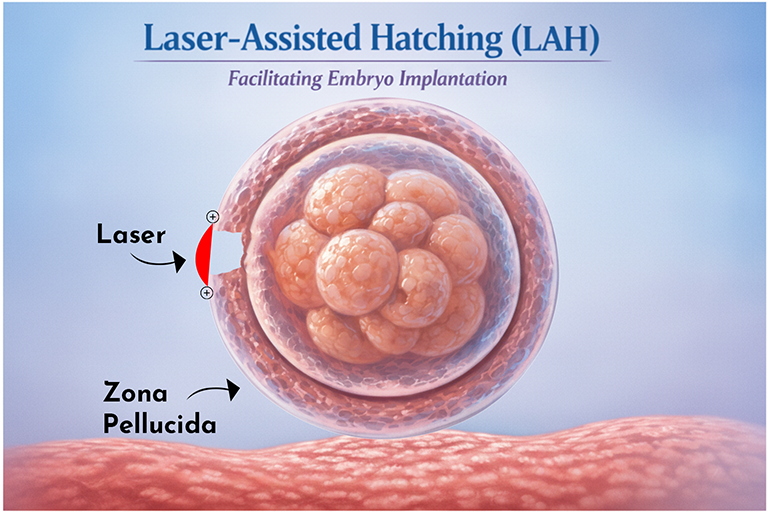
Laser-Assisted Hatching (LAH) is a specialized laboratory procedure where a precision laser is used to create a microscopic opening in the zona pellucida (the outer shell of the embryo). This "helping hand" makes it easier for the embryo to break out—or hatch—and attach to the uterine lining, significantly improving the chances of successful implantation.
About This Treatment
What you need to know
The Science of Assisted Hatching
For a pregnancy to occur, the embryo must “hatch” from its protective shell to make physical contact with the uterus. In some cases, the shell is too thick or rigid, preventing this vital step regardless of the embryo’s quality. By utilizing Laser-Assisted Hatching in Bangalore at Aikya, we bypass this mechanical barrier using non-contact laser technology, ensuring the embryo’s energy is spent on implantation rather than struggling to break free.
Why Choose Aikya for Laser-Assisted Hatching?
- Precision Technology: We use the latest generation of infrared lasers that offer sub-millisecond accuracy, ensuring zero thermal damage to the embryo.
- Integrated Care: LAH is seamlessly combined with our Blastocyst Culture and PGT programs for a comprehensive success-oriented approach.
- Experienced Embryologists: Our team has performed hundreds of LAH procedures, balancing the delicate touch required for this microsurgery.
- Evidence-Based Success: We only recommend LAH when clinical indicators suggest it will actually improve your specific outcome.
Treatment Process
Step-by-step journey to better health
Microscopic Evaluation
Our embryologists examine the embryo under high magnification to determine the thickness of the outer shell.
Precision Laser Pulse
Using a specialized inverted microscope, a highly focused laser beam creates a tiny, controlled thinning or opening in the shell.
Safety First
The laser is “non-contact,” meaning it never touches the cells of the embryo; it only affects the acellular outer protein layer.
Immediate Transfer
Once the shell is primed, the embryo is promptly prepared for transfer into the uterus to maximize its “hatching” potential.
Key Benefits
Why patients choose this treatment
Who Should Consider This?
Is this treatment right for you?
Women over the age of 35 (where the embryo shell may be naturally tougher).
- Couples with multiple unexplained IVF failures.
- Patients using Frozen Embryo Transfer (FET), as the freezing process can sometimes harden the outer shell.
- Cases where embryos have a thick zona pellucida as observed by the embryologist.
- Couples with high Basal FSH levels.
Important Considerations
What to discuss with your doctor
Please consult our specialists to understand how these considerations apply to your individual case.
- Expertise Required: While extremely safe, it requires a steady hand and high-end equipment to ensure the embryo’s internal cells are not disturbed.
- Natural Hatching: Not every patient needs LAH; if the shell is naturally thin, the procedure may not provide additional benefit.
Frequently Asked Questions
Answers to common questions
No. The laser only targets the zona pellucida, which is a non-living protective layer. It does not touch the genetic material or the cells that form the baby.
No. At Aikya, we believe in “personalized fertility.” We only perform LAH if our embryologists see a clinical need, such as thick shells or a history of implantation failure.
It can be performed on both, but it is most commonly used just before a Day 5 Blastocyst transfer for maximum effect.